 US Dollar
 Canadian

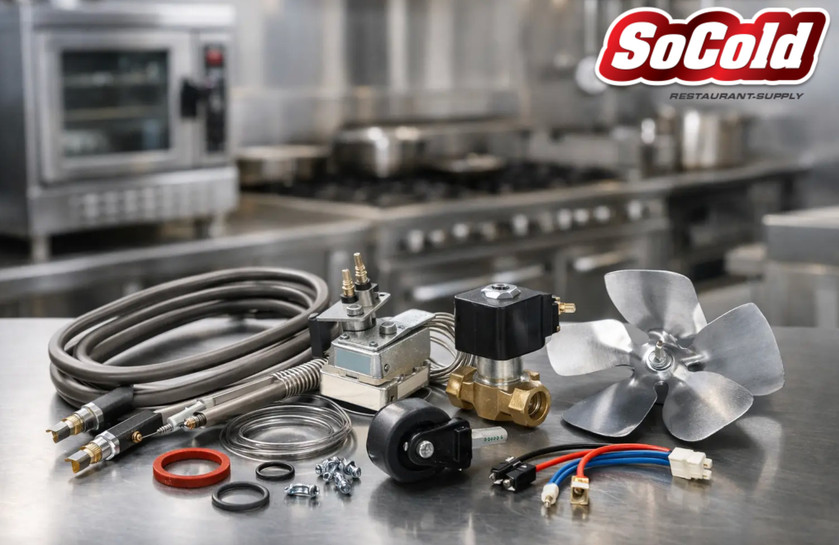
When a fryer goes down during lunch or an ice machine starts acting up before a busy weekend, the real question is not just what part you can get fastest. It is why use OEM replacement parts when cheaper options are sitting right next to them. For most commercial kitchens, the answer comes down to uptime, fit, safety, and the true cost of getting a repair wrong.
In foodservice, equipment is not a side issue. It drives output, ticket times, food safety, and labor efficiency. A bad replacement part can turn a quick fix into repeat service calls, uneven performance, or a unit that fails again under load. That is why many operators, maintenance teams, and service techs default to OEM parts when the equipment matters and the downtime is expensive.
Why use OEM replacement parts in commercial kitchens
OEM stands for original equipment manufacturer. An OEM replacement part is made to the same specifications as the part installed in the equipment when it was built. That does not automatically mean every repair needs OEM, but it does mean you are starting with the part designed for that exact machine, model, and operating conditions.
In a commercial kitchen, that matters more than it does in many other settings. Foodservice equipment runs hot, cold, wet, greasy, and hard for long hours. A thermostat that reads slightly off, a gasket that does not seal tightly, or a heating element that draws differently than expected can affect more than performance. It can affect food quality, sanitation, utility usage, and the lifespan of other components around it.
OEM parts reduce guesswork. Instead of hoping a part is close enough, you are buying to the original design standard. For a kitchen manager trying to reopen a station fast, or a technician trying to avoid a callback, that difference is practical, not theoretical.
The fit is usually the first big advantage
One of the most common problems with non-OEM parts is fit. On paper, a part may be listed as compatible. In practice, the mounting points may be slightly off, the wiring connectors may need modification, or the dimensions may be close but not exact.
That costs time immediately. A technician may need to adapt the installation, verify electrical or mechanical tolerances, or stop the job entirely. Even if the part can be made to work, labor time goes up. In a commercial environment, labor is part of the repair cost, and extra labor can erase any savings from buying a lower-cost part.
Exact fit also matters after installation. Door gaskets need to seal correctly. Valves need to regulate flow correctly. Sensors need to read in the right range and position. If the fit is off, the equipment may still run, but not at the level it should. That leaves operators dealing with inconsistent results and maintenance teams dealing with preventable repeat issues.
Performance is tied to the original design
Commercial equipment is built as a system. The fan motor, control board, sensor, ignitor, and switch are not random pieces. They are selected to work together within a certain performance range. When you replace one of those parts with something that is only approximately equivalent, you introduce variation into that system.
Sometimes that variation is minor. Sometimes it is enough to create nuisance shutdowns, slow recovery times, uneven cooking, poor refrigeration performance, or premature wear on nearby components. A cheaper part can become an expensive problem if it causes the machine to cycle incorrectly or work harder than intended.
This is especially relevant for refrigeration, heating, warewashing, and ice equipment. In those categories, small differences in part quality or spec can have outsized effects on temperature control, recovery speed, water management, and energy use.
OEM parts can help protect equipment life
When operators ask why use OEM replacement parts, the better question is often what happens to the rest of the machine if you do not. A part that is not built to the original specification can put stress on surrounding components. That may not show up the first day. It shows up a few months later when another part fails early, the machine starts running inefficiently, or service becomes more frequent.
For example, a poorly matched motor can affect airflow and overwork a system. A lower-grade gasket can let cold air escape and force refrigeration components to cycle more often. An off-spec thermostat can create temperature swings that impact both product quality and equipment strain. These are not unusual edge cases. They are common ways repair costs expand over time.
If the unit is a high-value asset or a core piece of production equipment, protecting its service life usually matters more than saving a small amount on one repair part.
Safety and compliance are harder to compromise on
Foodservice equipment operates in environments where safety is not optional. Gas components, electrical parts, thermostats, switches, and controls all have direct operational consequences. In many cases, using the correct OEM part is part of reducing risk.
A replacement part that does not perform to the right standard can create ignition issues, temperature control problems, leaks, electrical faults, or sanitation concerns. Even when an aftermarket part is marketed as compatible, compatibility does not always equal identical performance.
For operators in regulated environments, that matters. Schools, healthcare kitchens, chain locations, and institutional facilities generally need repairs that are predictable and defensible. The more critical the application, the less appetite there is for experimentation.
The cheapest part is not always the lowest-cost repair
Purchase price is easy to compare. Total repair cost is not. The lower-priced part can look like the smarter buy until you add technician time, shipping delays from reordering, downtime, spoiled product, lost service capacity, and callback labor.
If a busy prep cooler is out for an extra day because the first part did not fit right, that savings disappears fast. If a dishmachine goes down again after a short-term fix, labor and disruption may outweigh the original part cost several times over.
That does not mean aftermarket parts never make sense. On older equipment, non-critical components, or very budget-constrained repairs, they may be a reasonable option. But for key operational equipment, especially units that run daily and under pressure, OEM often wins on total value rather than upfront price.
When OEM is usually the better call
OEM replacement parts make the strongest case when the equipment is under warranty, the part affects safety or temperature control, the machine is a critical production asset, or the repair needs to be right the first time. They also make sense when the labor to access the part is significant. If it takes time to tear down a unit, you do not want to repeat that work because a lower-cost part failed early.
They are also a better choice when the model is brand-specific or uses specialized controls, boards, probes, or assemblies. The more complex the equipment, the more likely exact spec matters.
For service companies and in-house maintenance teams, OEM can also simplify troubleshooting. When the replacement matches the original part, diagnosing future issues is more straightforward. You remove one layer of uncertainty from the machine.
Why sourcing matters as much as part type
Even if you know you want OEM, finding the correct part fast is its own challenge. Commercial kitchens and service teams do not have time to hunt across multiple vendors, compare inconsistent naming, or guess at cross-references while equipment sits down.
That is why supplier structure matters. A parts source built around actual equipment brands, model families, and foodservice categories saves time before the order is ever placed. It helps buyers avoid mismatches and helps technicians get closer to a first-time fix.
For operations managing multiple equipment types, it also helps to work with a supplier that carries both replacement parts and the other day-to-day items the business needs. Consolidated purchasing cuts friction. SoCold Products serves that kind of buyer - operators and maintenance teams who need parts access without wasting time.
The real reason operators stick with OEM
Most experienced buyers are not paying extra for a label. They are paying to reduce uncertainty. OEM parts are often the fastest path to the right fit, the expected performance, and a repair that holds up under commercial use.
If a piece of equipment is mission-critical, every repair decision should be measured against downtime, labor, reliability, and risk. That is the practical answer to why use OEM replacement parts. They help you protect the machine, the shift, and the cost of the next problem you do not want to have.
When equipment is central to service, the better part is usually the one that lets you stop thinking about it and get back to running the kitchen.