 US Dollar
 Canadian

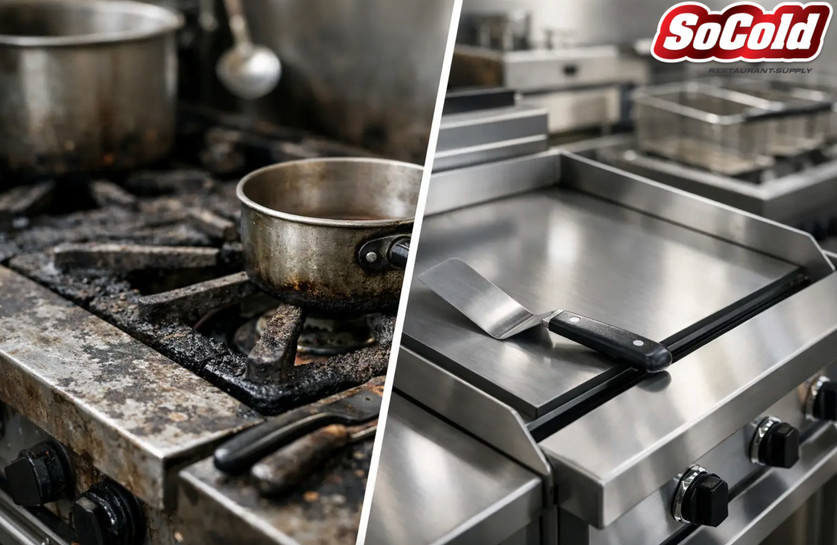
A reach-in cooler that runs warm during Friday dinner service usually settles the question faster than any spreadsheet. But most equipment decisions are not that obvious. If you are asking when should restaurant equipment be replaced, the real answer is not based on age alone. It comes down to uptime, repair frequency, food safety risk, operating cost, and whether the unit still fits the way your kitchen actually works.
For operators, chefs, service teams, and buyers, replacement is rarely just a capital expense decision. It is an operations decision. The wrong move can mean paying too much too early, or stretching a failing unit so long that it creates labor problems, inconsistent output, and emergency downtime at the worst possible time.
When should restaurant equipment be replaced instead of repaired?
The cleanest rule is this: replace equipment when the total cost and risk of keeping it in service is higher than the cost of replacing it. That sounds simple, but in a working kitchen, the details matter.
A fryer with one manageable repair in five years is different from a fryer that has needed two gas valve replacements, inconsistent temperature calibration, and repeated service calls during peak periods. A refrigeration unit that still runs but struggles to hold safe temperatures is not giving you useful extra life. It is creating exposure.
The repair-versus-replace decision usually turns on five factors at the same time: frequency of breakdowns, cost of parts and labor, availability of replacement parts, energy efficiency, and operational impact. If one of those is unfavorable, you can often keep repairing. If three or more are going the wrong direction, replacement usually makes more financial sense.
Age matters, but not as much as condition
Some operators want a hard timeline. Replace ice machines at X years, ovens at Y years, refrigeration at Z years. Useful as a rough planning tool, but not reliable enough for purchasing decisions on its own.
Equipment life varies by volume, cleaning practices, water quality, preventive maintenance, installation quality, and how heavily staff push the unit. A combi oven in a high-output institutional kitchen will age differently than the same model in a lower-volume operation. An ice machine with poor filtration may fail much sooner than one maintained on schedule.
That said, once equipment gets into the later part of its expected commercial life, replacement should at least be on the table. Not because old equipment is automatically bad, but because older units tend to create more expensive patterns: harder-to-source parts, more technician time, reduced efficiency, and more disruption to production.
The biggest signs replacement is overdue
Repeated repairs are the most common signal. If the same unit is generating service calls every few months, it is no longer a reliable asset. Even if each repair looks manageable by itself, the combined cost usually understates the real problem. You are also paying in staff workarounds, lost production time, spoiled product risk, and management attention.
Temperature inconsistency is another major warning sign. Refrigeration that cannot hold setpoint, hot holding equipment with uneven heat, or cooking equipment that no longer delivers consistent recovery times can affect both quality and compliance. Once performance drifts enough to change product results or food safety margins, replacement becomes less optional.
Rising utility use is another overlooked factor. Older refrigeration, warewashing, and cooking equipment often stays in service because it still technically runs. But if it is pulling more electricity, water, or gas than a newer equivalent, the operating cost gap can become meaningful, especially across multiple units or chain locations.
Visible deterioration matters too. Corrosion, damaged insulation, door seal failure, recurring leaks, compromised wiring, and frame damage are not cosmetic issues in a commercial environment. They often point to broader reliability and sanitation concerns.
A practical repair threshold
Many operators use an informal percentage rule. If a repair costs roughly half the price of replacement, especially on an older unit, replacement deserves serious consideration. That is not a universal cutoff, but it is a useful trigger.
For example, a three-year-old prep table with a single compressor issue may still be worth repairing. A ten-year-old prep table with compressor trouble, failing gaskets, poor recovery, and rusted shelving is a different case. Even if you fix the immediate failure, another issue may be close behind.
The same logic applies when parts become difficult to source. Once OEM-style parts, controls, or assemblies are delayed, discontinued, or priced high enough to distort the repair cost, your downtime exposure goes up. In a busy kitchen, a unit that can only be fixed after a long wait is already costing you more than the invoice suggests.
What downtime really costs
Downtime is where many replacement decisions get clearer. A failed dishwasher does not just need a repair. It can slow the line, increase labor pressure, force disposable use, or create sanitation bottlenecks. A failed freezer can trigger product loss. A dead ice machine can affect beverage service, food display, and guest experience in a matter of hours.
That is why critical-path equipment should be judged more aggressively than nonessential units. If a piece of equipment is central to service continuity, replacement often makes sense sooner. Reliability has a higher dollar value when the whole operation depends on it.
When should restaurant equipment be replaced for safety or compliance reasons?
Immediately, if the unit creates a safety hazard or can no longer support code-compliant operation.
This includes refrigeration that cannot maintain safe holding temperatures, gas equipment with ignition or combustion issues, electrical equipment with recurring shorts or damaged wiring, and warewashing systems that cannot reliably meet sanitizing requirements. If the equipment puts staff at risk, compromises food safety, or creates sanitation failures, the repair debate gets short.
There are also cases where the machine works, but no longer supports current operational standards. An old refrigerated prep unit that struggles under today’s menu volume may not be technically broken, but it can still be operationally unfit. The same is true when expansion, menu changes, or production shifts have outgrown the equipment’s capacity.
Replacement makes sense when the kitchen has changed
A lot of equipment gets replaced because the business changed before the equipment did. Maybe your lunch traffic doubled. Maybe off-premise packaging changed your hot holding needs. Maybe the chain standardized a menu item that requires tighter temperature control or higher throughput.
In those cases, replacement is not about failure. It is about fit. Equipment that is too small, too slow, too inconsistent, or too labor-intensive can quietly drain profitability even if it still powers on every day.
This is especially common with refrigeration, holding cabinets, prep equipment, and ice production. If crews are building workarounds around an old unit, that workaround has a cost. More labor steps, more opening and closing strain, slower ticket times, and storage overflow are all signs the operation may be carrying the wrong asset.
Plan replacement before it becomes urgent
Emergency replacement is usually the most expensive version of replacement. Choices get narrower, freight gets faster and pricier, and the team is buying under pressure. Planned replacement gives you time to compare specs, confirm dimensions and utilities, line up installation, and source any related parts or accessories without disrupting service more than necessary.
The best time to evaluate replacement is before peak season, not during it. Review service records. Look for repeat failures by category and location. Compare repair spending over the past 12 months against expected replacement cost. Identify units with parts availability problems. Then rank equipment by operational criticality.
For multi-unit operators, this process also helps standardize purchasing. If several locations are nursing the same aging platform, it may be smarter to replace proactively and simplify parts stocking, technician familiarity, and training.
Build a replacement file, not just a repair history
Most kitchens track breakdowns. Fewer track the information that helps make faster replacement decisions. Keep model numbers, install dates, serial data, major repair dates, average service cost, and known recurring issues in one place. Include dimensions, utility requirements, and any site-specific installation notes.
That file turns a future failure into a purchasing action instead of a scramble. It also makes it easier to source replacement parts while the unit is still viable, which can extend useful life without guesswork. For many operators, that balance matters. There is no benefit in replacing equipment early if the right part can restore stable performance at a reasonable cost.
A practical supply partner can help on both sides of that decision by making it easier to source either the replacement unit or the hard-to-find part that buys you more productive time.
The best replacement decision is rarely based on one number
There is no perfect age cutoff and no universal repair formula. A good replacement decision weighs the full picture: how often the unit fails, how costly the downtime is, whether performance is slipping, whether parts are still available, and whether the equipment still matches the operation.
If you are waiting for a machine to completely die before acting, you are usually waiting too long. The better move is to replace when the equipment stops being dependable, economical, or fit for the job. That is when replacement stops being a painful expense and starts being a way to protect service, labor, and margin.