 US Dollar
 Canadian

A cooler decision usually shows up after a space problem, not before one. Prep is backed up, line cooks are opening three different doors to find product, or overflow cases are taking up floor space meant for actual production. That is where the reach in vs walk in refrigeration question becomes less about preference and more about workflow, storage volume, and operating cost.
For most foodservice operations, the right answer depends on how inventory moves through the kitchen. A reach-in works best when speed, point-of-use access, and a smaller footprint matter most. A walk-in makes more sense when bulk storage, receiving volume, and menu scale start pushing past what upright cabinets can handle. The mistake is treating them as interchangeable, because they solve different problems.
Reach in vs walk in refrigeration: the real difference
At a basic level, reach-in refrigeration is an enclosed cabinet unit placed directly in the kitchen, prep area, service zone, or back room. It is designed for frequent access, organized shelf storage, and fast retrieval of smaller quantities. You see it in line stations, bakeries, bars, cafes, and compact restaurant kitchens because it keeps product close to where staff actually use it.
Walk-in refrigeration is built for larger-volume cold storage. It usually sits in a dedicated back-of-house area and gives operators room to store cases, pans, ingredient bins, and rolling racks. Instead of supporting quick grab-and-go access for every item, a walk-in supports inventory depth and bulk holding.
That sounds simple, but the difference affects labor, menu planning, receiving, sanitation routines, and how often staff have to restock during service.
When a reach-in is the better fit
A reach-in is often the practical choice for operators who need refrigeration close to the action. If your team is opening a refrigerator dozens or hundreds of times a shift, walking to a remote cooler every time is wasted motion. In those cases, an upright unit near the line or prep table reduces steps and keeps service moving.
Reach-ins also make sense when square footage is tight. Many kitchens simply do not have the room, layout flexibility, or install conditions for a walk-in box. For independent restaurants, coffee shops, concession operations, small institutional kitchens, and bars, a reach-in can deliver enough storage without forcing a remodel.
There is also the purchase decision to consider. In most cases, a reach-in has a lower upfront cost than a walk-in. Installation is usually simpler, and replacement is easier when a unit reaches the end of its service life. For operators trying to control capital spending, that matters.
The trade-off is capacity. Once your purchasing volume starts increasing, you can end up using multiple reach-ins to cover the same need. That can eat up floor space quickly, raise total energy use, and create a scattered storage setup where product is split between too many cabinets.
Reach-in strengths
The biggest advantage is accessibility. Staff can store and retrieve ingredients without leaving the workstation for long. Reach-ins are also easier to assign by function, such as dairy, proteins, garnishes, desserts, or beverage stock. That kind of organization helps with speed and reduces unnecessary door openings.
They also work well for operations with faster product turns. If inventory comes in more frequently and does not sit for long periods, a reach-in can support the volume without creating dead space.
Reach-in limitations
The downside is that growth exposes the limits fast. If your menu expands, catering business picks up, or your supplier deliveries become less frequent, a reach-in setup may stop being efficient. You may still have enough refrigerated cubic footage on paper, but not enough practical storage for full cases, sheet pans, backup prep, or organized rotation.
When a walk-in is the better fit
A walk-in earns its value when volume and storage discipline matter more than point-of-use convenience. High-volume restaurants, commissaries, institutions, chain locations, hotels, and operations with large weekly deliveries often need a walk-in because they are receiving product by the case, not just by the pan or insert.
With a walk-in, staff can stage inventory more effectively. That improves first-in, first-out rotation, keeps backup stock off the kitchen floor, and creates room for larger prep cycles. If your operation relies on batch prep, banquet production, or multi-day ingredient holding, a walk-in usually gives you more control.
There is also a labor angle that buyers sometimes miss. A walk-in can reduce the constant shuffle of restocking smaller cabinets during service. Instead of trying to fit all cold inventory into several reach-ins, teams can keep backups in one central location and replenish line units as needed.
The trade-off is cost and complexity. Walk-ins require more planning, more space, and a higher upfront investment. They also affect building layout, refrigeration components, and sometimes permitting or electrical considerations, depending on the installation.
Walk-in strengths
Capacity is the obvious one, but it is not the only one. A walk-in can simplify receiving, reduce clutter, and support better product separation. It also gives operators room to scale. If sales increase, you are less likely to hit a hard storage ceiling right away.
For kitchens dealing with broad SKU counts, that matters. A walk-in handles mixed inventory better than a bank of overfilled upright cabinets.
Walk-in limitations
A walk-in is not always the efficient answer for smaller operations. If your cold storage needs are modest, a large cooler can turn into underused square footage and unnecessary expense. It can also slow staff down if they have to leave the line constantly to retrieve product that should have been stored closer to the work area.
Cost is more than the purchase price
In reach in vs walk in refrigeration decisions, buyers often focus too much on initial equipment cost and not enough on total operating impact. A reach-in is usually less expensive to buy, but several reach-ins spread across the kitchen may increase energy consumption, service needs, and workflow inefficiency over time.
A walk-in generally costs more up front, but it may reduce product loss, improve storage organization, and support larger buying volumes that lower food cost per unit. That does not automatically make it cheaper long term. It just means the value depends on how your operation runs.
Maintenance matters too. Multiple reach-ins mean multiple compressors, door gaskets, hinges, thermostats, and service points. A walk-in has its own maintenance demands, but the issue is different. Instead of maintaining several separate cabinets, you are managing one larger refrigerated environment with its own components and door traffic patterns.
Space, layout, and traffic flow
Kitchen layout often decides this faster than budget does. If your back-of-house footprint is limited, a walk-in may not be realistic without giving up prep or dry storage space. If the kitchen is spread out and production is split across stations, reach-ins near each work area may be more useful than one central cold room.
But there is a point where adding more reach-ins starts creating congestion. Narrow aisles, blocked cleaning access, and extra heat output from surrounding equipment can all work against you. Once refrigeration starts dictating the layout instead of supporting it, the setup needs to be reconsidered.
This is why many larger operations use both. A walk-in handles bulk inventory and receiving, while reach-ins support line access, prep staging, or specialty storage. That combination usually reflects actual kitchen behavior better than an all-or-nothing approach.
How to decide what fits your operation
Start with delivery frequency, average on-hand inventory, and where product is used during a shift. If you receive smaller shipments multiple times a week and need quick access at the line, a reach-in may be enough. If you receive bulk orders, run multiple dayparts, or hold a wide range of perishable inventory, a walk-in is usually the stronger choice.
Then look at labor movement. Count how often staff leave their stations for refrigerated product. If too much time is spent restocking or searching, the issue may not be capacity alone. It may be placement.
Finally, think about growth. If you are already near the limit of your current refrigerated storage, replacing one small problem with another does not help. Buyers who plan for the next two to three years usually make better refrigeration decisions than buyers solving only this month’s shortage.
For many operators, the best move is not choosing one over the other in theory. It is matching storage type to how the kitchen actually works. If your cold storage supports receiving, prep, service, and sanitation without forcing extra steps, you are on the right track. That is usually the difference between equipment that merely chills product and equipment that helps the operation run cleaner, faster, and with fewer workarounds.
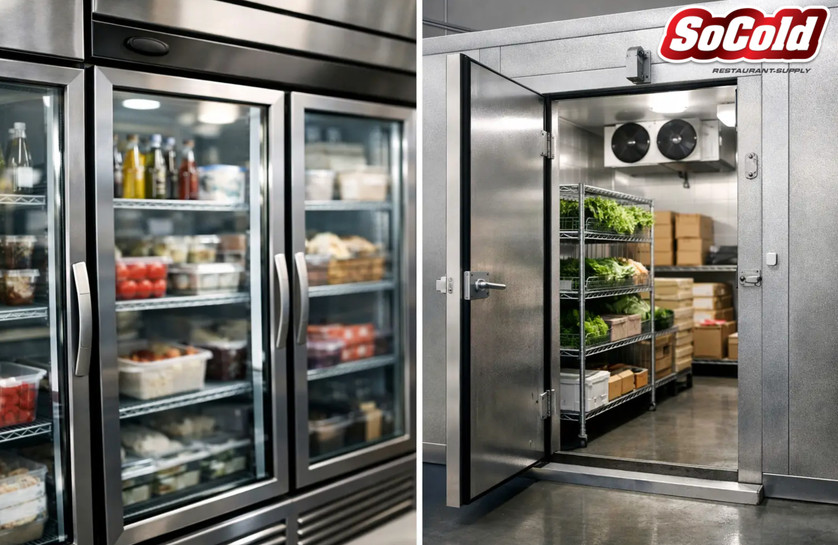
Reach In vs Walk In Refrigeration
Posted by Steve MM on 23rd Jun 2026