 US Dollar
 Canadian

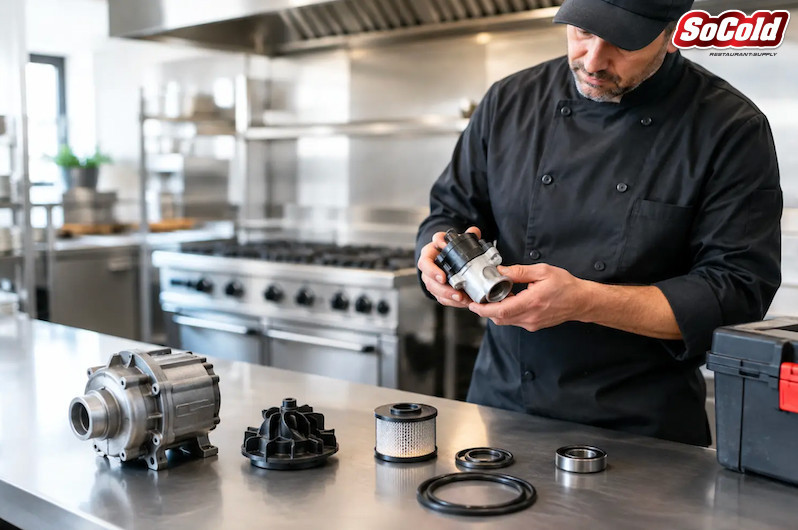
A failed $18 capacitor can take a reach-in refrigerator out of service just as surely as a failed compressor. That is the point behind a kitchen downtime reduction parts example: identify the small, failure-prone components that stop production, then keep the right replacements available before the dinner rush makes the problem expensive.
For commercial kitchens, the goal is not to build a warehouse full of random parts. It is to stock a controlled set of verified spares based on equipment criticality, failure history, lead times, and the cost of losing that piece of equipment for several hours or several days.
Kitchen Downtime Reduction Parts Example: A Reach-In Cooler
Consider a busy restaurant with two reach-in refrigerators on the line. One unit holds prep ingredients for lunch and dinner service. When its evaporator fan motor fails, the cabinet temperature rises, product must be moved, prep space becomes limited, and staff lose time managing a preventable emergency.
A practical spare-parts package for that refrigerator may include a matching evaporator fan motor, compatible motor blade, start relay, overload protector, run capacitor, door gasket, temperature control or probe, and a set of common fasteners. Not every operation needs every item on the shelf. The correct selection depends on the make, model, voltage, and service record of the unit.
The motor and capacitor are strong candidates for on-site inventory when the refrigerator is production-critical and replacement parts are not locally available the same day. A gasket is also worth considering because damaged gaskets create a slower failure: warm-air infiltration raises run time, stresses refrigeration components, and can eventually contribute to temperature problems. A temperature probe may be a better choice for equipment that uses electronic controls and has a history of inaccurate readings or alarm faults.
This approach turns a service call from a parts-search delay into a repair. A qualified technician still needs to diagnose the actual failure. Keeping a part in stock does not mean replacing components by guesswork. It means the correct component is available when the diagnosis is complete.
Start With Equipment That Can Stop Service
Parts planning should begin with a short list of equipment that creates immediate operational disruption when it fails. For many restaurants, that includes walk-in refrigeration, reach-ins, ice machines, dish machines, fryers, ovens, ranges, holding cabinets, and food processors. For institutional kitchens, steam equipment, warewashing systems, and large refrigeration systems may carry even higher priority.
The purchase price of the equipment is not the best way to rank it. A lower-cost fryer that produces half the menu may be more urgent than an expensive oven used only for a limited item. Ask a direct question: if this machine is unavailable at 11:30 a.m. or 5:30 p.m., what happens to production?
Also account for redundancy. A kitchen with three similar fryers can usually tolerate one down for a short period. A single ice machine serving a high-volume bar, however, may have no backup. Equipment without redundancy deserves closer attention, especially when a replacement part has a long lead time.
Parts Worth Keeping vs. Parts Worth Ordering
The best on-site spares are relatively affordable, model-specific enough to prevent substitution errors, and likely to fail before the equipment reaches the end of its useful life. They should also be parts that a technician can install safely without waiting on a special order.
Common examples include capacitors, contactors, relays, igniters, thermocouples, temperature probes, fan motors, door gaskets, water inlet valves, float switches, spray nozzles, solenoids, belts, knobs, filters, and pilot assemblies. Depending on the equipment, a control board may also be justified, but only when its history and lead time support the cost of holding one.
Large-ticket components require a different decision. Compressors, refrigeration condensing units, motors with uncommon specifications, and proprietary control assemblies can tie up budget and may have limited shelf-life or return eligibility. In many cases, it makes more sense to document the exact part number, confirm availability, and establish a fast purchasing process rather than stock the item.
Consumable maintenance items should be handled separately from emergency spares. Water filters, fryer filter paper, warewashing chemicals, descaling products, refrigeration coil cleaner, and replacement cutting blades help prevent failures, but they are replenishment products. Keeping them organized is still downtime reduction, because skipped maintenance often becomes an urgent repair later.
Verify the Part Before You Buy It
A part that is close but not correct does not reduce downtime. It adds another delay, may create a return issue, and can leave the kitchen with a disassembled machine during a service window.
Start with the equipment data plate. Record the manufacturer, complete model number, serial number, voltage, phase, and any revision information. For electrical components, confirm ratings, terminals, rotation, dimensions, and mounting details. For refrigeration and gas equipment, verify specifications through the manufacturer parts breakdown or a qualified service source.
Do not rely only on the appearance of the old part. Different versions of the same equipment model can use different controls, motors, or valves. A clear equipment register with photos of data plates and installed components gives managers, purchasers, and service technicians one reliable reference when time matters.
Label Parts for the Equipment They Serve
Store each spare in a labeled bin or sealed bag marked with the equipment name, location, manufacturer part number, and installation notes. For example: “Prep Line Reach-In 2, evaporator fan motor, 115V, verify blade set screw before install.”
This is especially useful across multi-unit operations. A generic label such as “fan motor” invites the wrong part to be used on the wrong unit. Include the date received and review old inventory periodically, particularly electronic controls, gaskets, adhesives, and chemicals with storage requirements.
Build a Simple Parts Plan Around Real Failures
Maintenance teams and service vendors usually know which components fail repeatedly. Use work orders, invoices, and technician reports from the previous 12 to 24 months to find patterns. If the same ice machine valve has been replaced twice, or several door gaskets have failed on one cooler bank, those items deserve review.
A workable plan can track four details for each recommended spare:
- Equipment and location
- Exact part number and approved replacement
- Typical failure symptoms and service history
- Current stock level, supplier lead time, and reorder point
The reorder point matters. If a kitchen has one spare igniter and uses it during an emergency repair, that part should be reordered immediately, not added to a vague monthly purchasing list. Treat critical spares as controlled inventory, not miscellaneous maintenance supplies.
For chains and larger facilities, standardizing equipment models can reduce the number of parts required. If several locations use the same compatible fan motor, valve, or control family, central inventory becomes more useful. The trade-off is that standardization must not force an inferior equipment choice just to simplify the parts shelf.
Pair Parts Inventory With Preventive Maintenance
Stocked parts are the recovery side of downtime reduction. Preventive maintenance is the prevention side. Clean condenser coils, clear drain lines, inspect gaskets, check fryer controls, descale ice machines, replace water filters, and maintain dish machine components on schedule. These tasks reduce stress on the parts most likely to fail during service.
A recurring temperature issue, for example, may not be a bad control. It could be a blocked condenser, worn gasket, dirty evaporator coil, failed fan, or improper loading pattern. Replacing parts without addressing the underlying condition wastes money and can create repeat downtime.
Purchasing teams should coordinate with operators and technicians before setting stocking levels. Operators know which equipment is essential during service. Technicians know which parts actually fail and which substitutions are unsafe or unreliable. Procurement can then balance availability, price, storage space, and lead time.
SoCold Products can support this process by consolidating replacement parts, maintenance supplies, sanitation items, and operating essentials into a purchasing workflow that is easier to manage than multiple emergency vendor searches.
The useful closing standard is simple: every critical piece of equipment should have a known failure plan. Record the exact part, keep it on hand when the cost of delay justifies it, and make sure preventive maintenance gives that spare part fewer chances to be needed.