 US Dollar
 Canadian

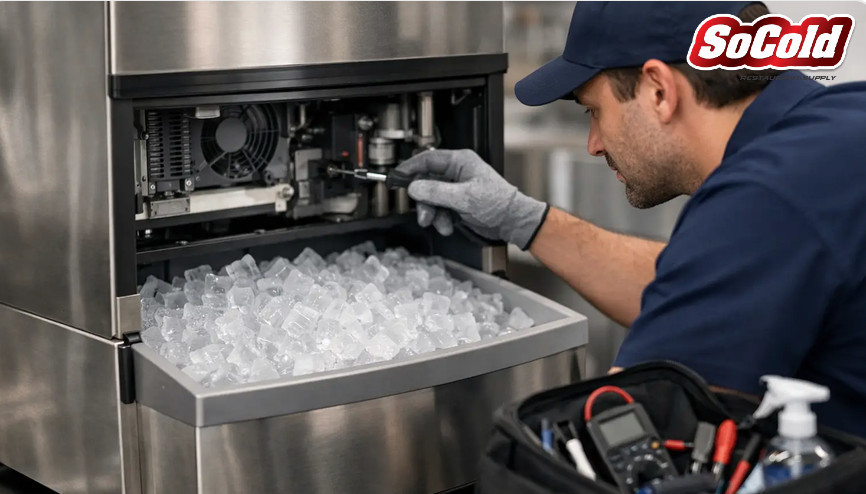
A slow ice machine rarely fails without warning. Ice gets thinner or cloudy, harvest cycles take longer, bins develop odor, and staff start buying bagged ice to get through service. Knowing how to maintain ice machines turns those early signals into routine work instead of an emergency repair call during a busy shift.
Commercial ice equipment needs more than an occasional wipe-down. It handles food, water, heat, airborne grease, and constant use, often in tight back-of-house spaces. A practical maintenance program protects sanitation, production capacity, energy use, and the life of high-cost components.
Start With the Manufacturer's Requirements
Every ice machine has model-specific instructions for cleaning chemical concentration, sanitizer type, water-filter replacement, and component access. Follow the equipment manual first, especially for the approved cleaner and sanitizer. Using the wrong chemical can damage nickel-plated evaporators, plastics, seals, or internal tubing. It can also create a warranty issue.
Maintenance frequency depends on the local water supply, volume of ice produced, kitchen conditions, and machine type. A hotel breakfast operation with light production may have different needs than a restaurant running a full cube machine through lunch, dinner, and bar service. Hard water, high mineral content, airborne flour, grease, and poor ventilation all shorten the interval between cleanings.
As a baseline, schedule a full clean and sanitize at least every six months. In demanding conditions, quarterly cleaning may be the more economical choice. Waiting until scale is visible or ice quality declines usually means the machine has already lost efficiency.
Daily and Weekly Ice Machine Checks
Daily checks take only a few minutes and give operators a reliable picture of machine performance. Assign them to a shift lead, manager, or designated maintenance employee so the work is not treated as an optional closing task.
Check these points during normal operation:
* Confirm the bin has clean, dry-looking ice with no unusual odor, discoloration, or soft melting texture.
* Listen for changes in fan, compressor, pump, or harvest-cycle noise.
* Verify that the machine is making and releasing ice on its normal cycle.
* Keep the scoop clean, stored outside the ice, and protected from splash or hand contact.
* Wipe spills from the exterior and keep boxes, chemicals, and debris away from air intake and exhaust areas.
Never store food, bottles, bags, or tools in an ice bin. Ice is food, and the bin is a food-contact area. A common sanitation failure is using the bin as convenient cold storage or leaving the scoop buried in the ice where employees handle the scoop and ice together.
Each week, inspect the floor around the equipment, drain connection, supply line, and visible fittings for water. Small leaks can become slip hazards, damage flooring, or signal a loose fitting before it becomes a shutdown. Check that the drain remains open and that the drain line is not kinked, crushed, or backing up.
Clean the Food Zone on Schedule
The food zone includes the evaporator area, water trough, distribution system, curtain or damper, bin, and other components that contact water or ice. This is where scale, slime, and biofilm can reduce output and create sanitation risk.
Before cleaning, turn off the machine according to the manufacturer's procedure and remove all ice from the bin. Do not serve or reuse ice that was present during cleaning. Disconnect power only when the manual calls for it, particularly before accessing internal components.
Use a manufacturer-approved ice machine cleaner to remove mineral scale. Mix it exactly as directed. Stronger is not better: excess concentration can damage parts and leave residue, while weak solution may not remove deposits. Allow the prescribed contact time, then rinse thoroughly through the unit's cleaning cycle or as directed by the manufacturer.
After descaling and rinsing, apply an approved foodservice sanitizer at the correct concentration. Sanitizer does not replace cleaner. Cleaner removes mineral buildup and soil; sanitizer reduces microorganisms on already-clean surfaces. Treating a scaled or dirty surface with sanitizer alone is not a complete maintenance process.
Remove accessible components such as water curtains, distribution tubes, float parts, and bin accessories only if the manual permits it. Clean and sanitize these parts separately, then reinstall them correctly. Improperly seated curtains or water distribution components can cause uneven ice formation, water overflow, or a failed harvest cycle.
Protect Water Quality With Filtration
Water filtration is one of the highest-value maintenance items on a commercial ice machine. Filters reduce sediment, chlorine taste and odor, and scale-forming minerals depending on the cartridge design. Better incoming water helps protect valves, pumps, evaporators, and distribution passages while improving ice appearance and taste.
Replace cartridges on the schedule specified for the filter and local water conditions, not only when staff notice bad-tasting ice. A filter can become restricted before quality complaints begin. Restricted flow may reduce production or lead to incomplete cube formation.
Record the installation date and replacement due date on the filter head or in a maintenance log. If your location uses multiple machines, label each filter by machine. This avoids the frequent problem of changing one cartridge while another unit is overlooked for months.
Filtration is not a substitute for cleaning. Even filtered water can leave minerals behind, and filters do not prevent airborne contaminants, bin contamination, or drain problems. Think of filtration as protection for the machine, not permission to extend sanitation intervals indefinitely.
Keep Air-Cooled Machines Breathing
Most commercial ice machines are air-cooled, which means they depend on clear airflow across a condenser. When the condenser is blocked with dust, grease, lint, or flour, the machine runs hotter and longer. Production drops, energy use rises, and compressors face unnecessary stress.
Inspect the air filter, louver, and condenser area regularly. Clean removable air filters according to the manufacturer's instructions. For accessible condenser fins, use a soft brush or approved vacuum method that does not bend the fins. Do not spray water or chemical degreaser into electrical components, and do not use aggressive tools that flatten the coil.
The cleaning interval depends heavily on the location. A machine near a fryer line, bakery prep area, loading door, or dusty utility space may need attention monthly or more often. A unit in a clean, well-ventilated beverage station may require less frequent service. Maintain the required clearance around the machine so hot discharge air is not pulled back into the condenser.
Water-cooled and remote-cooled models have different needs. Water-cooled units may require attention to water-regulating valves and water consumption, while remote systems may need qualified refrigeration service. Do not assume every ice machine follows the same condenser maintenance routine.
Inspect Parts Before They Stop Production
Some failures are not preventable, but many can be caught during planned inspection. Look for worn door gaskets, cracked water curtains, damaged bin liners, brittle tubing, loose fittings, corroded fasteners, and leaking water valves. Replace worn parts before they create a sanitation issue or interrupt production.
Pay close attention to the water pump and distribution system. Weak water flow, blocked nozzles, or uneven water sheets can produce thin, hollow, or misshapen cubes. If the machine has a purge cycle, confirm it is operating correctly. Purging concentrated mineral water helps control scale between full cleanings.
Keep a simple maintenance log with the cleaning date, filter change, observed issues, parts replaced, and technician visits. For multi-unit operations, record the model and serial number as well. This gives managers a service history, helps technicians diagnose recurring issues, and makes it easier to order the correct replacement part without delaying a repair.
Know When to Call a Qualified Technician
Routine cleaning and inspection can be handled in-house when staff are trained and the manufacturer permits it. Refrigeration-system work, electrical diagnosis, control-board issues, compressor problems, and persistent harvest failures should go to a qualified service technician.
Call for service when the machine repeatedly trips breakers, leaks refrigerant, makes grinding or severe vibration noises, produces far below its rated capacity after cleaning, or displays recurring error codes. Also act quickly if water is leaking inside electrical areas or the machine will not complete a freeze or harvest cycle.
Do not keep resetting a machine that is clearly malfunctioning. Repeated restarts can turn a minor control, pump, or airflow issue into a larger repair. If ice production is critical to the operation, have a contingency plan for bagged ice or access to another unit while service is scheduled.
A clean ice machine is easier to operate, easier to inspect, and far less likely to create a costly surprise during service. Put the cleaning dates on the calendar, keep filters and common replacement parts on hand, and treat every change in ice quality or production as an early maintenance signal.