 US Dollar
 Canadian

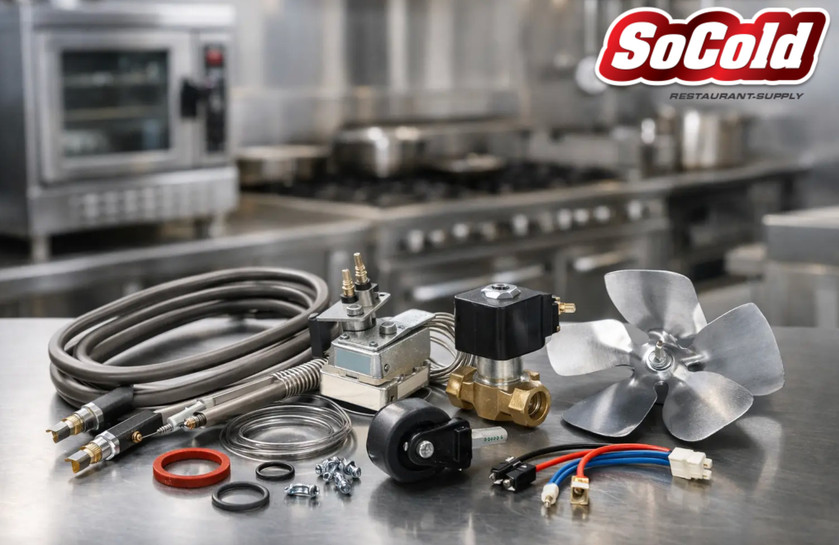
A fryer down at lunch, an ice machine leaking before weekend service, a reach-in not holding temp overnight - most equipment failures are not budget problems first. They are uptime problems. That is why foodservice equipment parts matter so much in commercial kitchens. The right part, identified quickly and ordered correctly, can be the difference between a routine repair and a full day of lost production.
For operators, purchasers, and service techs, buying parts is rarely a casual task. Usually, the clock is already running. The challenge is not just finding a replacement. It is finding the correct replacement for the exact unit, with enough confidence to avoid a second order, another service call, or more downtime.
Why foodservice equipment parts are a purchasing priority
In a commercial kitchen, replacement parts support much more than repair. They protect labor, food safety, service consistency, and equipment life. A failed door gasket on refrigeration may seem minor until product temperatures start drifting. A worn wash arm, switch, valve, or thermostat can slowly reduce performance before the failure becomes obvious.
That is why smart buyers do not treat parts as an afterthought. They treat them as part of operating continuity. In many cases, a relatively low-cost component keeps a much larger capital asset in service. Replacing a sensor, igniter, fan motor, or control board is often far more practical than replacing the unit, but only if the part is available and matched correctly.
There is also a cost control angle that matters. Emergency purchases tend to get expensive when the item is misidentified, backordered, or sourced from the wrong channel. Ordering accurately the first time reduces freight waste, technician revisits, and the hidden labor cost of chasing specifications across multiple vendors.
What makes foodservice equipment parts hard to source
Parts buying sounds simple until model variations get involved. Commercial equipment lines change over time. Manufacturers revise designs. Similar-looking units may use different components based on serial range, voltage, gas type, region, or production year. A heating element that looks right can still be wrong. A controller with the same layout may carry a different programming setup.
That is why generic visual matching is risky. The safest path is always to work from the manufacturer model number, serial number, and equipment type. For some categories, you also need details such as left-hand or right-hand orientation, dimensions, connection style, pressure rating, or electrical specs.
Another issue is naming. Different buyers may search for the same item using different terms. One person looks for a door seal, another for a gasket, another for a magnetic gasket. A technician may know the assembly name while a kitchen manager knows only the symptom. Strong category organization helps bridge that gap, especially when parts are grouped by equipment type and brand.
What to confirm before you order
Before purchasing any replacement part, start with the equipment data plate. Capture the brand, full model number, and serial number exactly as shown. If the machine has had prior field modifications, note that too. On older equipment, a previous repair may have introduced a substitute component that is not original to the unit.
Next, confirm the failure point instead of jumping straight to the most visible symptom. A freezer not cooling may need a fan motor, relay, thermostat, or control component. A dishwasher with poor results may have a chemical feed issue, pump problem, clogged spray component, or heating fault. Ordering from symptoms alone can turn one repair into two.
It also helps to decide whether you need an individual component or a full assembly. Sometimes buying the smaller item saves money. Other times, the assembly saves labor and reduces the chance of missing related wear items. It depends on the equipment, the technician’s time, and how critical the unit is to production.
OEM, aftermarket, and branded replacement options
Not every part decision is purely about price. Fit, consistency, and lead time all matter. OEM parts are typically chosen when exact specification and manufacturer alignment are the priority. They are common for controls, safety components, and situations where warranty, calibration, or exact compatibility matters.
Aftermarket or OEM-style options can make sense when they are well matched to the application and available faster or at a better cost. That can be especially useful for high-turn maintenance items and older equipment where operators want to keep units running without overinvesting.
The trade-off is straightforward. Lower purchase cost does not help if the part creates fitment issues or shortened service life. At the same time, the highest-priced option is not automatically the best buying decision for every machine. For aging equipment near end of life, many kitchens make practical, case-by-case choices based on remaining asset value and service urgency.
The parts categories that usually drive downtime
Some categories generate repeat demand because they wear out under normal commercial use. Refrigeration parts such as gaskets, hinges, fan motors, controllers, probes, and defrost components are frequent needs. Cooking equipment often requires thermocouples, igniters, knobs, switches, thermostats, elements, and pilot-related parts. Dish machines commonly need curtains, rinse arms, pumps, valves, heaters, and chemical tubing.
Ice machines add another layer because routine maintenance parts and repair parts often overlap. Water filters, pumps, probes, bin controls, and inlet components all affect output and sanitation. Prep equipment, beverage systems, and holding cabinets bring their own mix of seals, blades, controls, casters, and electrical parts.
For multi-unit operators and franchise groups, the pattern is usually clear. A small number of parts categories account for a large share of service events. Once that pattern is identified, stocking selected critical spares starts making sense.
When it makes sense to stock common foodservice equipment parts
Not every operation should build a large parts room. Excess inventory ties up cash and creates its own tracking problems. But for high-volume kitchens, chains, institutions, and facilities teams, keeping a focused set of common foodservice equipment parts on hand can cut downtime significantly.
The best candidates are items with predictable wear, short replacement time, and direct impact on service. Think gaskets, knobs, switches, pilot assemblies, filters, probe sensors, common valves, and casters. If a site runs multiple identical units, the case for stocking gets even stronger because one part can support several pieces of equipment.
The wrong candidates are slow-moving, high-cost components with uncertain shelf life or highly specific fitment. Control boards, specialized compressors, and niche assemblies are usually better sourced as needed unless failure history justifies stocking them.
How to buy faster without increasing errors
Speed matters, but speed without accuracy creates delays. The most efficient buyers build a repeatable process. They keep equipment lists current, record model and serial information before failures happen, and standardize how requests are submitted from store level to purchasing or maintenance.
Clear product organization also saves time. Buyers should be able to search by equipment brand, equipment type, and part category without guessing how the item is labeled. That is one reason broad-line suppliers are useful. When one source carries equipment, everyday operating supplies, and replacement parts in the same purchasing environment, teams spend less time jumping between vendors while handling urgent and routine needs together.
Photos can help confirm obvious physical details, but they should support identification, not replace model-based verification. If the application is safety-sensitive or electrically specific, a second check is worth the extra few minutes.
Repair or replace depends on more than part cost
A part may be affordable while the total repair is not. Labor, freight, unit age, downtime exposure, and the likelihood of another failure all matter. Replacing a low-cost thermostat on a fairly new oven is an easy call. Replacing a major board on an aging unit with declining reliability is less clear.
The practical question is whether the repair restores dependable service at a sensible total cost. For core production equipment, a repair may still be the right move even when it is not cheap, simply because replacement lead times are longer than the operation can tolerate. In other cases, repeated small failures are a sign that the unit is consuming labor and attention beyond its value.
This is where disciplined parts purchasing helps. Good records show which units are eating service dollars and which parts fail repeatedly. That turns maintenance from guesswork into a usable operating decision.
A better way to think about parts sourcing
Parts buying works best when it is treated as an operations function, not just a last-minute transaction. The goal is not merely to locate a component. The goal is to restore equipment with the least disruption, the fewest ordering mistakes, and the best fit for the unit’s role in the kitchen.
That means accurate identification, practical sourcing, and a supplier structure built for real commercial demand. If you are buying for one independent kitchen or managing a multi-site program, the same rule applies: the easier it is to find the right part quickly, the easier it is to protect service, labor, and equipment life.
A good parts process does not get much attention when everything is running. That is exactly the point. When the next failure hits, you want the repair to feel routine, not urgent.