 US Dollar
 Canadian

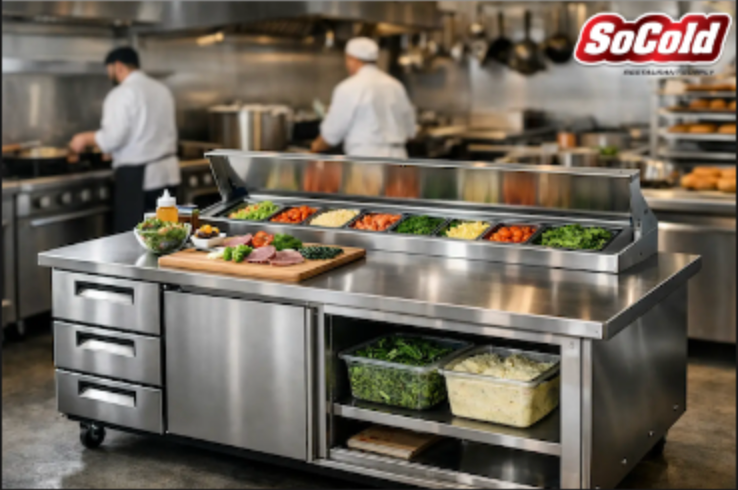
A prep table that runs warm at the rail, crowds the line, or cannot hold the pans your menu requires will slow service fast. This commercial prep table review focuses on the details that affect daily production: refrigerated pan capacity, usable cutting-board space, compressor performance, cleaning access, and the cost of keeping the unit in service.
A commercial prep table is not simply refrigerated storage with a top rail. It is a production station. The right unit keeps ingredients at usable temperatures, puts high-volume items within reach, and gives staff enough workspace to assemble orders without crossing the kitchen for backups. The wrong one creates wasted motion, product loss, and maintenance calls during the busiest shift.
Commercial Prep Table Review: What to Evaluate First
Start with the menu and the station, not the exterior dimensions. A sandwich shop, pizza operation, salad line, and institutional kitchen may all use prep tables, but their pan layouts, topping volume, and recovery needs are different.
The first decision is generally the table style. Sandwich and salad prep tables typically use a raised refrigerated rail with a wide cutting board. Pizza prep tables use larger pans and a deeper work surface for dough handling and topping assembly. Mega-top units increase pan capacity in a similar footprint, but the additional rail space can reduce the available cutting-board depth. That trade-off matters when employees build large sandwiches, salads, or bowls directly on the board.
Before comparing brands or price points, measure the actual installation area. Account for door swing, rear and side clearance, ventilation requirements, wall protection, and employee traffic. A unit that technically fits between two pieces of equipment may still be difficult to clean or service.
Pan capacity should match peak production
Pan count is one of the most visible specifications, but it can be misleading. A rail listed for 12 pans may accommodate standard 1/6-size pans, while your operation needs a mix of 1/3, 1/6, and 1/9 pans. Confirm the included pan configuration and whether adapters are available for the layout you use.
Capacity should support the busiest period without forcing staff to overfill pans. Overfilled pans can interfere with covers, reduce airflow around product, and make portioning messy. If a rail constantly runs empty, a higher-capacity mega-top may be justified. If several pans regularly hold low-volume items, a standard rail with a better undercounter storage layout may be the more efficient purchase.
Also consider pan depth. Deeper pans reduce refill trips, but shallow pans may be better for fast-moving items that need frequent replacement for freshness or temperature control. A practical setup often uses different depths based on ingredient turnover rather than one uniform pan size.
Refrigeration performance is more than the cabinet temperature
The refrigerated base and top rail serve different jobs. The base holds backup product and often sees frequent door openings. The rail must maintain safe product temperatures while exposed to warmer kitchen air and repeated pan access. Review the operating temperature range, refrigeration system design, and manufacturer guidance for ambient conditions.
Units with forced-air circulation generally provide more consistent cooling than passive designs, but airflow still depends on clean coils, unobstructed vents, proper pan placement, and intact gaskets. A table installed beside a charbroiler, fryer, or oven may struggle if the surrounding heat load exceeds its intended operating environment. In that case, moving the unit or adding a heat barrier can be more effective than buying a larger table.
Look at how the rail is covered during slower periods and overnight. Hinged insulated lids, removable covers, or roll-top covers can help protect product and reduce heat gain. The best option depends on the workflow. Hinged lids are simple and durable, but they need clearance behind the unit. Roll-top styles can save space, though tracks add another area to clean.
Work Surface and Base Storage Matter as Much as the Rail
The cutting board is where operators feel the difference between a well-chosen prep table and an undersized one. Check the board depth, thickness, material, and how easily it can be removed for cleaning or replacement. A wider board helps assembly work, but it also increases the unit’s overall depth and may affect aisle clearance.
High-density polyethylene boards are common because they are durable and food-safe, but they will eventually show knife marks. A replaceable board is a normal maintenance item, not a reason to replace the table. Keep a replacement plan in place if the station handles heavy knife work every day.
Base storage needs a separate review. Drawers are useful for portioned proteins, backup pans, and organized mise en place. Doors provide more flexible storage for larger containers and bulk items. For operations that use both, a combination drawer-and-door configuration can reduce clutter, but it may cost more and create more components to maintain.
Check the internal usable space rather than relying only on cubic-foot ratings. Shelf placement, evaporator location, drawer pan capacity, and door construction affect what actually fits. If your team stores hotel pans, dough boxes, or tall squeeze-bottle racks, verify dimensions before ordering.
Build Quality and Service Access Affect Total Cost
A low purchase price can become expensive when a prep table is hard to clean, difficult to repair, or unavailable for parts. Stainless steel exterior construction is standard in commercial equipment, but gauge, cabinet reinforcement, drawer slides, hinges, casters, and gasket quality vary by model.
Open and close the doors and drawers if possible. They should seal firmly without excessive force. Drawer slides should support loaded pans without binding. Casters should roll smoothly and lock securely, especially on equipment that must be moved for floor cleaning. Small hardware failures create daily frustration long before a compressor fails.
Service access deserves close attention. Technicians need reasonable access to the compressor compartment, condenser coil, fan motors, controls, and drain components. Front-breathing or rear-breathing design affects where the table can be installed and how the condenser receives airflow. Do not assume a unit can sit flush against a wall without checking the manufacturer’s clearance requirements.
Cleaning access is equally important. Crumbs, food debris, and spills collect under cutting boards, inside lid hinges, around pan rails, and behind drawers. Tables with removable components and smooth interior corners are easier to maintain. A unit that staff can clean correctly during closing will generally perform better than one with inaccessible buildup around the refrigeration system.
Size the Table for the Actual Line
For a compact sandwich station, a 27-inch or 48-inch table may be enough when ingredients are limited and replenishment is close by. A high-volume deli, fast-casual bowl concept, or multi-person assembly line may need a 60-inch or 72-inch model with a larger rail and more refrigerated base storage.
Bigger is not automatically better. An oversized table can consume valuable line space, increase energy use, and leave low-turnover ingredients sitting too long. It also may encourage teams to keep too much product in the rail rather than maintaining a disciplined replenishment routine. The best size is the one that supports peak demand while keeping the station organized and reachable.
For pizza operations, account for dough preparation, sauce application, cheese handling, and topping volume. A pizza prep table needs enough board depth to work comfortably and enough rail capacity to stage toppings without crowding. A standard sandwich prep table may look less expensive but can become a poor fit once dough trays and large ingredient pans enter the workflow.
Questions to Ask Before Purchasing
Confirm the electrical requirements, plug type, overall dimensions, shipping path, and whether the receiving area can handle the unit. Measure doorways, elevators, tight turns, and the final installation route. Freight delivery does not solve an access problem inside the building.
Ask what is included with the table. Pans, covers, shelves, casters, cutting boards, and drawer dividers are not always packaged the same way across manufacturers. Verify the warranty terms for parts, labor, and compressor coverage, then consider how quickly replacement components can be sourced if a fan motor, controller, gasket, or drawer slide fails.
For multi-unit operators, standardizing on a manageable number of models can simplify staff training, preventive maintenance, and spare-parts inventory. SoCold Products can be useful when you need to source the table along with food pans, cleaning chemicals, replacement gaskets, thermometers, and other operating supplies through one purchasing channel.
A commercial prep table earns its space when it keeps the line moving without becoming another maintenance problem. Buy for your menu volume, your available workspace, and the way staff actually build orders. Then keep the rail clean, the condenser maintained, and replacement parts available before a minor failure turns into a service interruption.