 US Dollar
 Canadian

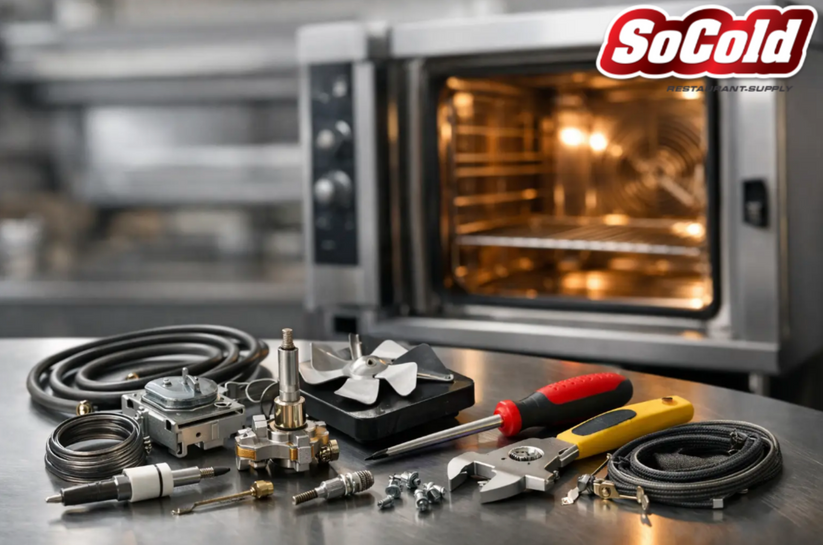
When a commercial oven goes down in the middle of service, the problem is rarely the whole unit. More often, one failed component shuts down heat, airflow, ignition, or controls. That is where a commercial oven parts guide saves time. If you know which part does what, what tends to fail, and how to match replacements correctly, you can shorten downtime and avoid ordering the wrong item.
For restaurant operators, maintenance teams, and service techs, oven parts buying is not just a repair task. It is an uptime decision. A delayed igniter, mismatched thermostat, or wrong door gasket can leave a line waiting on a fix that should have taken one order.
Commercial oven parts guide: start with the oven type
Before looking at individual components, identify the oven category. Parts vary widely between convection ovens, deck ovens, conveyor ovens, combi ovens, and countertop commercial units. Even within the same brand, two similar-looking ovens may use different switches, probes, motors, or control boards based on model series and production date.
Gas ovens typically center their most common failures around ignition, gas flow, temperature regulation, and safety components. Electric ovens more often involve elements, relays, contactors, control boards, and wiring-related failures. Convection models add fan motors, blower wheels, and door switches to the list. If the oven has steam or programmable cooking functions, the parts list gets more specialized fast.
That is why the model and serial number matter first. In commercial equipment, visual matching is risky. A part can look identical and still have the wrong voltage, mounting pattern, resistance value, or connector type.
The oven parts that fail most often
Some components account for a large share of commercial oven repairs. Knowing these categories helps narrow the issue before you order.
Igniters and pilot components
On gas ovens, igniters are one of the most common wear items. A weak igniter may glow but fail to draw enough current to open the gas valve consistently. That creates intermittent heat, delayed ignition, or a no-heat complaint. Pilot assemblies, flame sensors, spark electrodes, and related hardware also wear out over time, especially in high-volume kitchens where ovens cycle constantly.
If the oven lights inconsistently or takes too long to reach temperature, start here. But it depends on the system design. Some ovens use hot surface ignition, others use direct spark, and the replacement part must match that setup exactly.
Heating elements
Electric ovens rely on bake elements, broil elements, and other heating assemblies that eventually fail from repeated thermal cycling. A burned-out element may be visibly cracked or blistered, but not always. In some cases, the issue is reduced output rather than total failure.
If the oven is heating unevenly or not recovering properly, inspect the element along with the wiring and terminals. Replacing the element alone will not solve a problem caused by a damaged connection or failed relay.
Thermostats, probes, and temperature controls
When an oven runs too hot, too cold, or drifts from the set point, the fault often traces back to the thermostat, temperature sensor, RTD probe, thermocouple, or control board. Older ovens may use mechanical thermostats. Newer units depend more heavily on electronic sensing and digital controls.
These parts are easy to misdiagnose because the symptom feels simple while the cause may not be. A bad probe can mimic a bad board. A loose connection can mimic a bad thermostat. If the kitchen is seeing temperature inconsistency, check the full control chain instead of swapping one part based on a guess.
Fan motors and airflow parts
In convection ovens, airflow is the cooking system. If the fan motor weakens, seizes, or runs intermittently, cooking quality drops fast. Products bake unevenly, recovery slows, and hot spots become obvious. Related parts include blower wheels, motor mounts, cooling fans, and fan switches.
Grease buildup and heat exposure shorten life on these components. If a convection oven is noisy, slow to circulate air, or not moving air at all, the motor assembly deserves attention right away.
Door gaskets, hinges, and latches
A leaking oven door may not look like an urgent repair, but it affects temperature retention, energy use, cook consistency, and operator safety. Door gaskets compress and crack over time. Hinges sag. Latches stop sealing properly. In high-use kitchens, these mechanical parts can wear faster than internal controls.
This is one of the easiest places to lose efficiency without noticing it. If the oven struggles to hold heat or the door does not close cleanly, replacing these parts can improve performance without touching the heating system.
Switches, relays, and contactors
Selector switches, rocker switches, door switches, relays, and contactors handle routine on-off operation and power transfer. When they fail, symptoms can look random - no heat, no fan, partial function, or intermittent startup. On electric ovens especially, relay and contactor failures are common after years of heavy cycling.
These parts need exact electrical matching. Similar appearance is not enough. Voltage, amperage, pole configuration, and duty rating all matter.
How to identify the right replacement part
The fastest way to waste time is to order by guesswork. Start with the manufacturer name, full model number, and serial number from the data plate. Then confirm the part description, OEM number, and any revision notes tied to that model.
For commercial kitchens with multiple ovens, verify which unit actually needs the part. It sounds obvious, but in chain operations and institutional kitchens, equipment records are often incomplete. A buyer may have the right brand but the wrong cavity size, gas type, or electrical configuration.
Photos help, but they are a backup tool. The better approach is matching by documented equipment data first and visual confirmation second. This matters most with controls, sensors, ignition components, motors, and boards, where one small spec difference can turn a rush order into a return.
OEM, OEM-style, and aftermarket considerations
Not every replacement decision has the same priority. For safety parts, ignition systems, electronic controls, and brand-specific assemblies, exact fit and specification matter more than shaving a few dollars. With wear items like knobs, handles, or some mechanical hardware, buyers may have more flexibility depending on the application.
The trade-off is simple. Lower-cost alternatives can reduce immediate spend, but they may introduce fit issues, shorter service life, or compatibility problems. For a backup oven in a light-duty environment, that risk may be acceptable. For a high-volume line during peak season, it usually is not.
A practical purchasing approach is to prioritize proven compatibility and speed for critical failures, then evaluate cost options for non-critical replacements and planned maintenance stock.
Stocking strategy for operators and service teams
A good commercial oven parts guide is not only about emergency repairs. It should also help you decide what to keep on hand. If you operate several identical ovens, carrying a few high-failure parts can prevent expensive downtime. Igniters, door gaskets, knobs, switches, pilot parts, and common probes are often worth stocking when the equipment is essential to service.
For service companies and multi-unit operators, standardizing this spare-parts approach by brand and model saves real labor. Techs spend less time sourcing. Managers spend less time approving emergency buys. Purchasing teams get more predictable spend instead of repeated overnight orders.
This is where a broad supplier matters. If you are already buying cleaning chemicals, smallwares, disposables, and replacement parts from the same source, reordering gets faster and less fragmented. For operations trying to reduce purchasing friction, that efficiency matters as much as unit price.
Common mistakes that slow repairs
The most common mistake is ordering a part based only on appearance or a partial model number. The second is replacing the most obvious failed component without checking the upstream cause. A burned igniter might be the real failure, or it might be one symptom of a gas valve or control issue. A failed element may have been damaged by a loose terminal. A new fan motor may not last if the blower wheel or capacitor problem is ignored.
Another costly mistake is waiting too long on small mechanical issues. A worn gasket, loose hinge, or damaged knob does not feel urgent until it affects output, operator handling, or temperature stability. These lower-cost parts often offer the fastest performance improvement per dollar spent.
When speed matters more than price
Not every part purchase should be treated as a line-item cost comparison. If one failed oven backs up a school cafeteria, chain location, bakery, or prep-heavy restaurant, the labor loss and service disruption can outweigh the part cost quickly. In those cases, availability and shipping speed are part of the value.
That is why buyers often work with suppliers that can support both planned replenishment and urgent repair orders. SoCold Products fits that model well for foodservice operations that need broad coverage across equipment parts and day-to-day operating supplies.
The best time to make oven parts buying easier is before the next failure. Keep model numbers organized, track your high-failure components, and treat replacement parts as an uptime category, not an afterthought.