 US Dollar
 Canadian

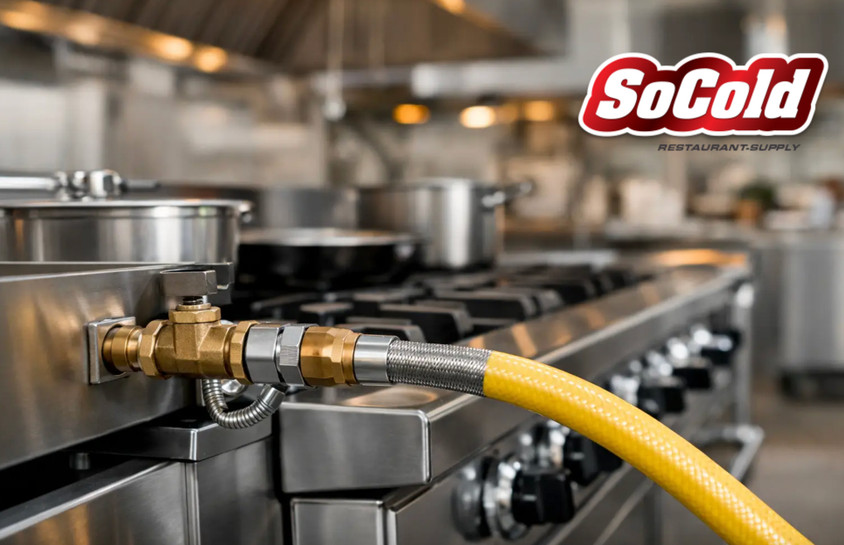
When a range gets pulled for cleaning or a fryer is swapped during a rush, the commercial gas hose for restaurant equipment stops being a small line item and starts being a downtime issue. If the hose is undersized, overbent, missing the right quick-disconnect, or simply worn out, you are dealing with more than inconvenience. You are dealing with safety risk, failed inspections, and equipment that cannot go back into service.
This is one of those parts that buyers often revisit only when something breaks. That is understandable, but it is not ideal. In a commercial kitchen, the gas connector assembly has to match the equipment, the gas type, the movement of the unit, and the installation environment. A hose that works on one cookline does not automatically belong on another.
What a commercial gas hose for restaurant equipment actually needs to do
A commercial gas hose is not just a flexible connector. In foodservice, it is usually part of a working assembly that may include fittings, a quick-disconnect, and a restraining device. Its job is to deliver gas safely while allowing enough movement for cleaning, service, or repositioning.
That sounds simple until you look at actual kitchen conditions. Equipment gets rolled out, pushed back too far, exposed to grease, bumped by carts, and reconnected by different staff over time. The right hose has to hold up under repeated movement without kinking, leaking, or creating a strain point at the connection.
This is why buyers should think in terms of the full application, not just hose length. A gas connector for a stationary oven in a tight alcove is a different purchase than one for a mobile fryer battery that is regularly moved for cleaning.
Start with the equipment and gas setup
Before you choose a replacement, confirm what the equipment requires. That means checking the gas type, inlet size, connector size, and the BTU demand of the unit. Natural gas and LP applications are not interchangeable just because a hose physically fits.
Capacity matters as much as thread size. A hose that is too small for the equipment load can affect performance, especially on high-demand cooking equipment. Burners may not deliver properly, recovery times can suffer, and troubleshooting can go in the wrong direction because the connector was treated like a generic part.
Length also needs a practical approach. Too short, and the hose can be strained every time the unit is moved. Too long, and you create slack that can snag, twist, or sit where grease and debris collect. The right length supports the actual range of movement without excess.
Hose diameter, length, and flow are not separate decisions
Buyers sometimes focus on getting the exact same hose length as the old one, but that only solves one part of the problem. Diameter, connection type, and gas flow have to work together.
For lower-demand equipment, a smaller diameter may be acceptable. For larger ranges, charbroilers, and high-output fryers, the required flow may push you into a larger connector size. If you are replacing a failed hose and the original installation had performance complaints, it is worth checking whether the old assembly was underspecified from the start.
The layout behind the equipment matters too. If the gas shutoff, wall connection, and equipment inlet create an awkward angle, a technically correct hose can still fail early from stress. In those cases, the best replacement may involve different fitting orientation or a better-matched assembly rather than a like-for-like swap.
Quick-disconnects and restraint cables matter more than people think
In many restaurant applications, the hose is only one part of the setup. Mobile gas equipment commonly uses a quick-disconnect for service access and a restraining cable to prevent the unit from being pulled beyond the safe range of the connector.
That restraint is not an accessory in the casual sense. It helps prevent the connector from taking the full force when staff move the equipment too far. Without it, the hose and fittings absorb stress they were not meant to carry. Over time, that can lead to wear, damaged ends, or unsafe conditions.
Quick-disconnects also need to match the system correctly. Size mismatch, poor fit, or using incompatible components from mixed assemblies can create avoidable problems. If a kitchen is replacing only one piece of an older setup, compatibility should be checked before the order is placed.
Code compliance is not the place to guess
Commercial gas connections are governed by applicable local and national requirements, and those requirements can vary by jurisdiction and installation type. That means the right product is not just the one that fits the equipment. It also has to be acceptable for the installation.
For operators and purchasers, the practical takeaway is simple. Verify that the hose and related components are rated and intended for commercial foodservice gas applications. Confirm any local requirements that affect connector type, length, movement range, and restraint. If a licensed technician is involved in the install, get their input before ordering rather than after a failed inspection.
This is especially relevant in multi-unit operations and institutional settings, where standardized purchasing can save time but also spread the same mistake across several sites. Consistency is useful only when the specified part is actually correct for all locations.
Signs your gas hose should be replaced
A failed hose does not always announce itself dramatically. In many kitchens, the warning signs show up first as wear, stiffness, corrosion, damaged outer braid, stressed fittings, or a connector that no longer sits naturally when the equipment is moved.
Repeated cleaning cycles can expose the assembly to chemicals, moisture, and handling damage. Grease buildup can hide wear. Older connectors may still be functioning but no longer be the best risk to carry, especially on heavily moved equipment.
If a unit has been relocated, converted, repaired, or reconfigured, it is smart to review the gas connection at the same time. A hose that was acceptable in the previous position may now be too short, routed poorly, or paired with fittings that create unnecessary tension.
Buying replacement hoses without slowing down the kitchen
When a kitchen needs a replacement fast, speed matters. But speed without the right specs can create a second delay. The most efficient buyers usually gather a few details before placing the order: equipment type, gas type, inlet and outlet sizes, required hose length, whether a quick-disconnect is needed, and whether the unit is movable and requires restraint.
Photos of the existing setup can help, especially for maintenance teams managing multiple locations. Model information is useful, but field conditions still matter because installations change. What is on the spec sheet may not fully reflect what is behind the appliance today.
It also helps to think ahead. If a site has several similar units on the line, stocking a correct spare assembly can cut downtime. That is particularly true for chains, schools, healthcare kitchens, and any operation where waiting on a failed gas connector can interrupt a large volume of meals.
Common buying mistakes
The most common mistake is treating the gas hose like a universal commodity. It is not. Similar-looking connectors can differ in capacity, fitting type, mobility rating, and intended use.
Another mistake is replacing only the damaged visible part while reusing worn components around it. If the quick-disconnect is binding or the restraint is missing, a new hose alone may not solve the underlying problem. A third issue is ordering based on approximate measurements. Close enough is not a good standard for gas connections.
Price-only buying can also backfire. In a commercial kitchen, a lower-cost hose that fails early or does not fit the installation correctly is rarely the cheaper option once labor, service calls, and downtime are included.
What to look for from a supplier
For this category, product access and clear specs matter more than marketing language. Buyers need to identify the correct connector quickly, compare sizes and configurations, and source related items in the same order if needed. That may include shutoff valves, quick-disconnect components, restraints, and other replacement parts tied to the equipment install.
This is where a broad-line supplier can save real time. If you are already sourcing cooking equipment parts, plumbing items, cleaning supplies, and smallwares from one place, adding a commercial gas connector to the same workflow reduces purchasing friction. For operators trying to keep a line running, that convenience is not cosmetic. It is operational.
If you are reviewing options through a supplier like SoCold Products, the real value is in finding the right spec without wasting hours across multiple vendors. That matters most when the replacement is urgent and the kitchen cannot afford a second ordering mistake.
A good commercial gas hose purchase is usually a quiet one. It fits the equipment, passes inspection, handles movement properly, and disappears back into daily service. That is exactly what you want from a part that only gets attention when something goes wrong.