 US Dollar
 Canadian

A bent shelf in a commercial freezer does more damage than it looks like on paper. It cuts usable storage, throws off product organization, slows rotation, and can create sanitation headaches when coatings crack or rust starts to show. Commercial freezer shelves replacement is usually a small repair compared with compressor or door work, but it directly affects daily throughput.
For most operators, the real issue is not whether to replace a shelf. It is how to get the right one fast, without ordering the wrong size, guessing on compatibility, or buying a part that fails early in a high-moisture, low-temperature environment. That is where a little attention up front saves a lot of wasted time.
When commercial freezer shelves replacement makes sense
Some shelf problems are obvious. Welds break, corners bend, support clips go missing, and the shelf starts sagging under normal product loads. Other cases are less dramatic but just as disruptive. The shelf coating may be peeling, the wire may be corroding, or the surface may no longer clean up to an acceptable standard.
In a commercial setting, replacement usually makes more sense than trying to force a damaged shelf back into service. Straightening a bent shelf can weaken the structure. Repainting or coating over damage is rarely a durable fix, and it can create food safety concerns if the finish flakes. If the shelf no longer sits level, fits securely, or holds product weight as intended, replacing it is the cleaner move.
There is also the productivity side. A freezer that cannot be organized properly costs labor every day. Staff spend more time shifting cases, rotating product by hand, and working around dead space. One missing shelf can turn a functional reach-in or walk-in section into a bottleneck.
Start with fit, not material
Buyers often start by looking at stainless steel versus coated wire, but fit should come first. Even a high-quality shelf is useless if the dimensions are off by half an inch or the support style does not match the cabinet.
Measure width and depth carefully, and do it inside the cabinet where the shelf actually sits. Do not rely on rough exterior dimensions of the freezer. Commercial units can vary by brand, model, and interior configuration. Shelf depth, notch placement, clip type, and rail spacing all matter.
If the original shelf is still available, use it as the baseline. Measure the full outside dimensions and note how it mounts. If the old shelf is missing, check the model information on the freezer and confirm whether the replacement part is OEM, OEM-style, or a universal shelf designed for that footprint. Universal options can work well, but only when the support system lines up properly.
This is also where service technicians and maintenance teams save headaches by checking the supporting hardware at the same time. A new shelf installed on worn clips, damaged pilasters, or bent rails is not a complete repair.
Material choice depends on load and environment
Once fit is confirmed, material becomes the next decision. For commercial freezer shelves replacement, the right choice depends on what the unit stores, how often product is moved, and how hard the shelving gets hit during normal use.
Coated wire shelves are common because they are cost-effective, promote airflow, and work well in many reach-in applications. Good airflow helps maintain even cabinet temperatures, which matters in freezers where product recovery time is already a concern. But coatings can fail over time, especially in high-abuse environments or where heavy cases are dragged rather than lifted.
Stainless steel shelves usually cost more, but they offer advantages in durability and corrosion resistance. They are a strong choice when the freezer handles heavier loads, frequent stocking, or a tougher cleaning program. For institutions, chain operations, and high-volume kitchens, paying more for longer service life can make sense.
The trade-off is simple. If the shelf is in a lower-impact unit and budget is tight, coated wire may be the practical option. If the freezer sees constant use, rough handling, or repeated shelf failures, upgrading the material may reduce repeat purchases.
Weight capacity is not a minor detail
Shelf failure is often blamed on poor quality when the real problem is overloading. Frozen product is heavy, especially boxed meat, bulk proteins, and tightly packed cases. A shelf that looks fine under light storage can bow quickly when loaded with dense inventory.
Check the intended capacity and think about actual use, not ideal use. Kitchen staff do not always distribute weight evenly, and product gets stacked fast during delivery rushes. If one shelf consistently takes the heaviest inventory, that shelf should be spec'd for that reality.
This is where buying to the lowest price can backfire. A cheaper shelf that needs replacement again in a few months is not cheaper once labor, disruption, and repeat shipping are factored in. For procurement teams managing multiple locations, standardizing stronger replacement shelves in known problem units can reduce service calls.
Don’t ignore sanitation and coating failure
Freezer shelves do not get a pass on cleanliness because they sit below freezing. Packaging leaks, torn cases, ice buildup, and damaged coatings all create surfaces that are harder to clean and inspect. Once a shelf coating chips or rust develops, the problem tends to spread.
That matters for both sanitation and appearance. Operators know inspectors and internal auditors notice deteriorated storage components. So do employees. Damaged shelving sends the message that back-of-house maintenance is slipping, even if the rest of the equipment is being managed well.
When replacing shelves, look closely at whether the current issue came from age alone or from how the shelf is being used and cleaned. Harsh tools, chemical misuse, and repeated impact from product carts can shorten shelf life. If the same shelf position keeps failing, the answer may not be just another replacement part. It may be better handling practices or a tougher shelf specification.
OEM, OEM-style, or universal
There is no single right answer here. OEM shelves are the safest choice when exact fit and factory compatibility matter most. They are especially useful for buyers who want minimal guesswork or need to match an existing interior layout exactly.
OEM-style replacements can be a strong option when they are built to the same dimensions and support configuration. For many operators, they offer a practical balance of availability and cost. Universal shelves can also work, particularly for common cabinet sizes, but they require more attention to measurements and support hardware.
The more critical the freezer is to daily production, the less room there is for trial and error. If a unit supports core inventory and cannot sit partially offline, exact-match replacement is usually worth prioritizing. On less critical backup storage, a well-matched universal shelf may be enough.
What buyers should verify before ordering
Most ordering mistakes happen because the buyer checks only one dimension or assumes all shelves within a cabinet series are interchangeable. Before placing an order, confirm the freezer make and model, shelf width and depth, mounting style, material type, and whether clips or supports are included or sold separately.
It is also smart to look at the full interior condition. If multiple shelves are corroding or the supports are worn throughout the cabinet, replacing one shelf may only delay a broader fix. In some cases, ordering a full set is more efficient than replacing pieces one at a time. That can restore usable storage all at once and reduce repeat downtime.
For multi-unit operations, this is a good moment to document shelf specs by location. A simple internal record of freezer model numbers and shelf sizes makes future emergency orders much faster.
Speed matters, but accuracy matters more
In foodservice, everyone wants the part yesterday. That is understandable when storage space is already compromised. Still, overnighting the wrong shelf solves nothing.
A practical supplier should help buyers narrow by brand, model, dimensions, and replacement part type without forcing them through unnecessary back-and-forth. That is why organized parts access matters. Businesses like SoCold Products serve a real need here by combining replacement parts, equipment, and everyday operating supplies in one purchasing flow, which helps buyers handle repairs without splitting orders across multiple vendors.
The best purchase is the one that restores storage capacity quickly and does not create a second problem next week. That means matching the shelf to the cabinet, the load, and the actual pace of the kitchen.
If your freezer shelves are bent, rusting, or no longer supporting inventory the way they should, treat the issue like an operations problem, not just a parts order. A properly selected replacement shelf keeps product organized, protects storage capacity, and removes one more point of friction from a busy back-of-house day.
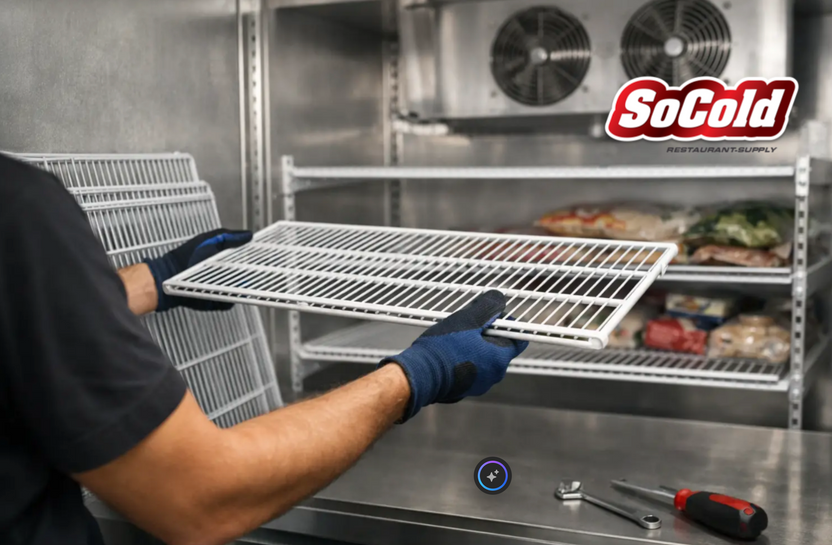
Commercial Freezer Shelves Replacement
Posted by Steve MM on 2nd Jun 2026