 US Dollar
 Canadian

A chef coat gets judged fast in a working kitchen. If it traps heat, stains badly, shrinks after a few washes, or limits movement on the line, staff notice on day one. That is why choosing chef coats for kitchen staff is less about appearance and more about heat management, durability, cleaning cycles, and whether the coat holds up through real service.
For operators, the wrong apparel choice creates small problems that repeat every shift. Cooks roll sleeves they should not roll, managers replace coats too often, and teams end up with inconsistent uniforms that look worn long before they should. The right coat does the opposite. It supports the pace of the kitchen, gives staff enough mobility to work cleanly and safely, and reduces replacement frequency.
What chef coats for kitchen staff need to do
In a commercial kitchen, uniforms are not a decorative category. They are part of daily operations. Chef coats need to stand up to heat, steam, grease, repeated laundering, and long hours of movement between prep, line, expo, and cleanup.
That means the first question is not whether a coat looks sharp on a hanger. The real question is whether it performs for the station and the workload. A saute cook working near high heat has different needs than a bakery employee, prep cook, culinary instructor, or front-facing open-kitchen chef. Some operations need traditional long-sleeve coverage for protection. Others benefit from lighter-weight or short-sleeve options where heat stress is the bigger issue.
This is where many buyers either overspend or underspec. A premium coat with details staff do not need can increase cost without improving function. On the other hand, the cheapest option may lose shape, stain permanently, or wear out so quickly that replacement costs erase any upfront savings.
Fabric choices matter more than most buyers expect
Fabric is usually the biggest factor in how a coat feels after four hours on the line and how it looks after fifty wash cycles. Cotton-rich coats are often preferred for comfort and breathability, but they can wrinkle more easily and may shrink if laundering is not controlled. Polyester blends usually offer better shape retention, easier care, and stronger stain resistance, which can make more sense for high-volume operations.
There is no perfect fabric for every kitchen. It depends on workload, wash process, and replacement expectations. If your staff sends uniforms through frequent commercial laundering, a poly-cotton blend often gives the most practical balance of comfort and lifespan. If presentation is a higher priority and the kitchen environment is somewhat less punishing, a higher cotton content may still be worth it.
Lightweight fabrics can improve comfort, but they are not always the best answer. In hotter kitchens they help reduce heat buildup, yet some lightweight coats show wear faster or offer less protection around splatter and steam. Heavier coats can feel more durable and traditional, but they may contribute to fatigue in already hot conditions.
Breathability and ventilation
Vent panels, mesh sections, and moisture-managing fabrics can make a noticeable difference, especially in open kitchens, busy restaurants, and institutional environments where staff stay in uniform for full shifts. A coat that breathes better often gets worn correctly throughout service. That matters more than a feature list on paper.
If your team regularly complains about heat, look at ventilation before assuming you need to change the whole uniform program. Often the issue is not the concept of chef coats itself. It is that the current coats are too heavy for the kitchen setup.
Fit affects safety, comfort, and consistency
Poor fit creates operational problems. Coats that are too tight restrict movement at the shoulders and arms, which is a problem on prep and line stations where repetitive motion is constant. Coats that are too loose can catch, bunch, or simply look sloppy by mid-shift.
A practical fit should allow reaching, lifting, bending, and turning without strain. That sounds basic, but many apparel problems come from buying one general style for every role without considering body types or job functions. If your operation has multiple positions with different physical demands, one coat style may not work equally well across the entire team.
Size availability matters too. Consistent uniforms are harder to maintain when common sizes are always backordered or specialty sizes are limited. Buyers should think beyond the first order and ask whether they can replenish the same style easily when turnover happens or seasonal staffing changes hit.
Snap, button, and closure options
Closure style is not a small detail. Traditional knot buttons can look classic, but they are not always the fastest or easiest option for high-turnover teams. Snap-front chef coats are often more practical for commercial operations because they speed up dressing, simplify replacement, and reduce fuss.
Double-breasted designs still make sense in many kitchens because they provide a more professional look and an added layer of protection. But if speed, easy care, and consistency matter more than formal presentation, simpler closures may be the better buy.
Appearance still matters, but function comes first
Uniforms affect how customers perceive an operation, especially in open kitchens, catering, hospitality, healthcare dining, and education settings. Clean, consistent chef coats help reinforce standards. They also help managers present a more organized back-of-house culture.
That said, appearance should not be separated from maintenance. White coats still signal a classic chef look, but they show stains fast and usually require more aggressive stain management. Black and darker colors can reduce the appearance of wear and may fit some concepts better, particularly in fast-casual, grill, or modern open-kitchen environments.
Embroidery and branding can add value if they support a polished presentation, but they also increase cost and may complicate quick replacement. For multi-unit operators or kitchens with frequent staffing changes, blank coats or simpler branded programs are often easier to manage.
Buying for turnover, laundry, and replacement cycles
The real cost of chef coats is not the unit price alone. It is the cost across repeated ordering, laundering, employee turnover, and loss. A coat that costs less upfront but needs early replacement can become the expensive option over time.
When evaluating chef coats for kitchen staff, it helps to think in terms of replacement planning. How many coats does each employee need to maintain hygiene and appearance between wash cycles? How fast can you reorder? Will the same style still be available next quarter? Can managers match new hires to the existing uniform without restarting the whole program?
These questions matter most for restaurants, chains, schools, healthcare kitchens, and contract foodservice operations where apparel is a recurring supply category rather than a one-time purchase. Operators often focus heavily on food cost, chemicals, disposables, and equipment uptime, but uniforms also affect continuity. If apparel purchasing is disorganized, managers end up spending time chasing basic replacements instead of handling service and staffing.
When to standardize and when to split by role
Not every kitchen should put every employee in the same coat. Standardization makes ordering easier and usually lowers complexity, but role-based selection can be smarter in some operations. Executive chefs and open-kitchen staff may need a more presentation-focused coat, while prep teams and back-line cooks may need lighter, easier-care garments built for frequent washing and hard use.
There is a trade-off. The more styles you carry, the more complicated replenishment becomes. But forcing one coat across every station can create comfort and performance issues. The right answer depends on staff count, concept type, and how centralized your purchasing process is.
For many operators, the best middle ground is a core standard coat for most staff, with one alternate style for specific roles or hotter stations. That keeps ordering manageable while still solving the biggest operational complaints.
Common mistakes buyers make
The most common mistake is treating chef coats as a minor accessory purchase. In reality, they are a frequently used operational item with direct impact on comfort, appearance, and replacement cost. The second mistake is choosing based only on upfront price. The third is failing to consider wash performance, which is where many uniforms start to fail.
Another issue is buying too narrow a quantity range. If you only order enough for current headcount, you leave no room for onboarding, damage, or delayed laundry cycles. Kitchens move fast. Apparel programs need a little buffer built in.
Suppliers with broad inventory across uniforms and other daily-use categories can simplify this process because buyers are already consolidating replenishment orders. For operations trying to reduce purchasing friction, that matters.
What a good decision looks like
A good chef coat decision usually looks boring on paper. The coats fit well, arrive consistently, wash clean, hold their shape, and do not become a staff complaint. They support the kitchen without requiring constant attention.
That is the point. In a busy operation, the best apparel choice is not the one with the most features. It is the one that keeps the team presentable, comfortable enough to work, and easy to outfit over time.
If you are reviewing uniforms, start with the job conditions, not the catalog image. Heat, movement, wash frequency, and replacement speed will tell you more than style names ever will. Buy for the kitchen you actually run, and the coats will do their job without slowing down anything else.
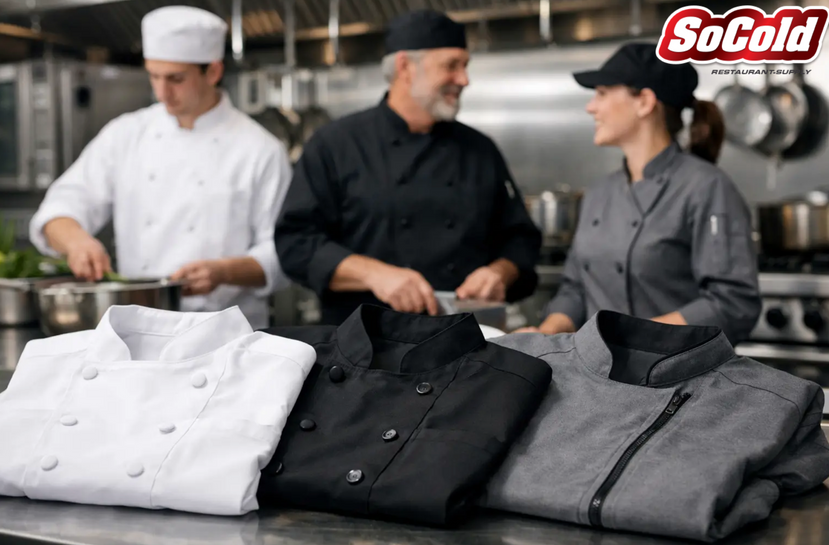
Choosing Chef Coats for Kitchen Staff
28th May 2026